

/prod01/channel_8/media/galleries/Clocktower-Gallery,-Canterbury.jpg)
Clocktower Gallery X UCA, June 2026 - October 2027
The Clocktower Gallery puts UCA creativity in Canterbury city centre through a rotating programme of exhibitions and artist talks by students and staff.
Current Exhibition: June-Sept 2026
Eszter Novák opens the Clocktower Gallery X UCA with ‘Obscurities Overheard’.
Artwork audio guide (a full text transcription is available at the bottom of this webpage):
Obscurities Overheard is a playful literary installation exploring some of the strangest words in the English language through illustration and storytelling. The exhibition features five tunnel book illustrations, each interpreting a different obscure word through humour and visual metaphor.
Alongside each piece, visitors can discover the word’s meaning, synonyms, and etymology, written in Eszter’s playful yet academic style. Connected to Canterbury’s literary history and the language of Christopher Marlowe, the exhibition celebrates the strange, theatrical, and often humorous side of the English language.
Accessible QR codes throughout the exhibition link to an audio guide read by the artist.
Events
The work continues as a multisensory installation in Eszter's graduate show just 5 mins from the Clocktower Gallery from:
12 – 24 June
Monday to Friday: 10am – 4pm
Saturdays: 10am – 3pm
Sundays: Closed
More about the exhibition
Obscurities Overheard… through history, through time. Some alive, but forgotten, some ready to be resurrected! Welcome to the realm of strange English words!
This installation began as a research project for Eszter’s undergraduate dissertation, where she explored how visual humour affects memorability. That research developed into the illustrated dictionary Obscurities, followed by the multisensory installation Obscurities Observed at Rochester House, and now Obscurities Overheard at the Clocktower Gallery.
The Clocktower Gallery exhibition explores five obscure English words through tunnel book illustrations, storytelling, and audio. Each piece is accompanied by the word’s meaning, synonyms, and etymology, written in the artist’s playful yet academic voice. Connected to Canterbury’s literary history and the language of Christopher Marlowe, the work celebrates the theatrical, peculiar, and unexpectedly expressive nature of the English language.
Accessible QR codes throughout the exhibition link to an audio guide read by the artist, designed to make the installation more accessible while adding another interpretive layer to the experience.
The installation also marks the release of Obscurities, available to pre-order now, and will be published in June.
Books are available to purchase directly in The Beaney, 18 High Street, Canterbury CT1 2RA.
Plus, visitors interested in a more tactile and auditory experience of five additional words can also explore Obscurities Observed at UCA’s Rochester House building between 12–24 June, Monday – Friday 10am – 4pm or Saturdays 10am – 3pm. It's just five minutes walk from the Clocktower Gallery.
About the artist
Eszter Novák is a Hungarian-British (“HunBrit” for short) artist, illustrator, and graphic designer with an incurable fascination for the weird, the comically obscure, the charmingly odd, and the wonderfully peculiar.
Before moving to the United Kingdom, she studied visual merchandising and window dressing in Budapest. She later completed both an Art Diploma and a Higher National Diploma in the UK, graduating with distinction before enrolling as a top-up student in Visual Communication at the University for the Creative Arts.
Alongside her studies, Eszter has worked for nine years as a freelance graphic designer under the name The Inspired Fox, specialising primarily in layouts, editorial design, and visually engaging communication. Her multidisciplinary approach combines influences from graphic design, illustration, spatial design, and storytelling.
Having had firsthand experience with people with different needs, accessibility remains an important consideration in her work to encourage wider engagement.
You can find more of her work and ongoing projects via LinkedIn and on Instagram at @theinspiredfox.illustration and @theinspiredfox.graphicdesign.
About the Clocktower Gallery
Inspired by New York's iconic venue founded by Alanna Heiss in 1972 the Clocktower Gallery offers a new way of experiencing art installed in a historic landmark. Heiss was a pioneering force in the early alternative‑spaces movement that reshaped how art could be presented. Her vision proved that unexpected, historic spaces could become powerful settings for contemporary work - an idea that continues to inspire artists and curators around the world. Prominently located at the top of Canterbury's busy high street the Clocktower Gallery reflects the way the historic city works in harmony with contemporary creativity and new ideas.

Further information
Hello and welcome to the realm of strange English words inside the Clocktower Gallery. Obscurities overheard, through history, through time, some alive but forgotten, some ready to be resurrected.
My name is Esther Nowak, the dreamer and creator of this playful literary installation that explores some of the strangest words in the English language through illustration and storytelling. I am a Hungarian-British artist, illustrator and graphic designer with an incurable fascination for the weird, the comically obscure, the charmingly odd,
and are wonderfully peculiar. This project grew from my dissertation research into how visual humor affects memorability, which later developed into the illustrated dictionary Obscurities and its companion installations.
The exhibition features five tunnel book illustrations, each interpreting a different obscure word through humour and visual metaphor. The words are arranged counterclockwise inside the clock tower in alphabetical order, and they can only be viewed from the outside. I'll guide you around with stops in front of the three remaining windows. Let's begin our journey. Scanning the QR code has positioned you in front of the clock tower entrance.
Turn 90 degrees clockwise and take approximately 4 steps. Turn 90 degrees counterclockwise and walk 4 more steps forward. If you turn counterclockwise once again, you will be facing a large window with 3 boards displayed behind it. The boards are 1 meter tall, stand on 4 black legs and are shaped like church windows to complement the setting.
Each board is divided into two sections. The upper section has a soft pastel peach background and contains a tunnel book illustration built into the surface. Beneath the illustration is an example sentence written in black italic lettering, adding humour and context. The drawings are created using linework and cross-hatching, giving them the appearance of old storybook engravings. A thick black strip runs across the middle of each board, displaying the featured word
Below this, on a pale greenish-blue background, you will find the definition, synonyms, etymology, and historical notes arranged in two columns. And now, without further ado, the first word is ignivomus, archaic adjective. Definition, spewing fire, vomiting fire, throwing out fire. Synonyms, fire-breathing, flamivomus. Etymology.
Igniformus is made up of the Latin ignis, meaning fire, and vomira, to vomit. According to the Oxford English Dictionary, the earliest evidence of this word is in Samuel Harsnet's A Declaration of Egregious Popish Impostures from 1603. He says,
What a monstrous coil would six or seven ignivomous priests keep in hell. Over a hundred years later, a member of the Royal Society of London, Thomas Forster of Boston, referred to ignivomous mountains in his 1721 writing, The World Alarmed, a surprising relation of a new burning island lately raised out of the sea near Tessera.
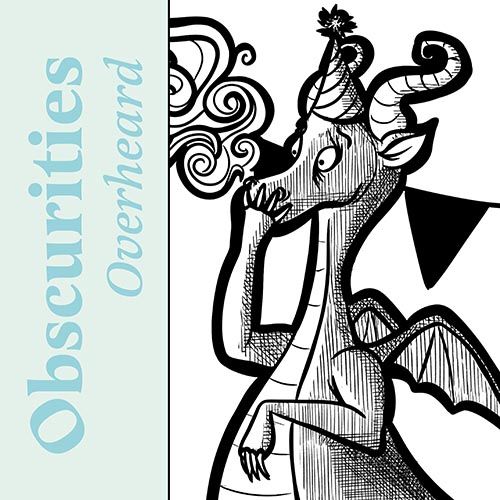
with a brief history of the other Ignavomus mountains at this day in the world. He preferred to keep it a mouthful instead of simply calling them volcanoes. Above, there's an illustration of a dragon wearing a party hat. He covers his mouth while looking down at a table where a birthday cake is on fire. The table is also on fire!
It is not fine. Smoke curls from the dragon's mouth, suggesting it calls the flames. Party bunting hangs in the background and the sign reads, Happy birthday. Caption text underneath reads, Being ignovomous is a badass thing, but it does have its drawbacks on your birthday. Oopsie. Take one sidestep to the right and you're in front of the second word.
jargoggle, obsolete verb, definition, simply to confuse, synonyms, confuse, bamboozle, mix up, muddle, befuddle, baffle, obfuscate, etymology, a word with uncertain origins, how very apt,
It is probably a combination of jargon, specialised language, and goggle, which comes from the Middle English gogglen, to roll the eyes. The first written evidence comes from the famous John Locke, English philosopher, physician, and political theorist. In his 1692 third letter for toleration, he says, I fear that the jumbling of those good and plausible words in your head
Might a little juggle your votes and lead you hoodwinked the round of your own beaten circle. I can't help but wonder why this word is obsolete. This sounds delightful. Is it because it would be just one too many words that mean to confuse? Try it. Say it. Let's breathe it back into circulation.
Above, there's an illustration of a bunny holding her head, her eyes spiralling in confusion. A scribble floats above her head. Behind her is a piece of impossible furniture assembled incorrectly, while an instruction booklet titled Bunkia lies in front of her. Caption text underneath reads, Too many instructions, one tiny, jar-goggled bunny. One more sidestep to the right takes you to the next word, quaff.
Verb. Definition. To drink heartily, to swallow in big gulps. Synonyms. Drink, gulp, swig, guzzle, slug. Etymology. The origin of this rather old word is uncertain, which is rather apt for vocabulary that described enthusiastic drinking. Some suggest it comes from the old Irish gwach, meaning cup, goblet, a vessel for hoarding drink.
While others insist it simply imitates the joyful sound one makes while glugging something down. To be fair, both explanations feel equally plausible after a pint. According to the Oxford English Dictionary, the earliest evidence comes from a 1520 work by the grammarian and schoolmaster Robert Whittington. However, I'm closing this entry with a quotation from Christopher Marlowe's poem, Ignotto.
And when all's quaffed, eat up my pousing glass, in glory that I am thy servile arse. Cheers. Above, there's an illustration of a wizard mouse holding a small bottle marked with a heart up to his mouth. His eyes are wide as he looks towards another bottle labelled H2O. Smoke curls from his ears, forming heart shapes.
A small bird nearby raises her wings as if trying to warn him. Caption text underneath reads, Too thirsty to sip, too small to chug. He simply quaffed until he realized his mistake. Turn 90 degrees clockwise. Take approximately four steps. Turn 90 degrees counterclockwise. Roughly five more steps forward. And if you turn 90 degrees counterclockwise again, you'll face the fourth board.
The word is womblecropped. Adjective. Definition. Being incapacitated by nausea or severe indigestion. Synonym. Crapulous. Etymology. Womblecropped comes from the Middle English verb womlen, to feel sick or nauseated, which is related to the Danish vama, to nauseate, and ultimately connected to the Latin vomire, to vomit.
The second element, cropped, refers to the Old English crop, the stomach or gullet of a bird, giving the whole word the vivid sense of having a queasy, overfull stomach. It first appears in the Obsidarium Anglico-Latinum, written by Richard Hewlett, lexicographer, in 1552. It charmingly describes Womble Crop Stomaticus, Womble Stomach, to be nauseo.
The direct quotation deserves a place right here by none other than Mark Forsyth, who has blessed us with such linguistic masterpieces as the Horologicon, the Etymologicon, and the Elements of Eloquence. Not like yours truly is the proud owner of these three. In the Horologicon, he states...
Womblecropped is the most exquisite word in the English language. Say it. Each syllable is intolerably beautiful. As musical as the word sounds, Armand decided whether he's taking the mickey. Above, an illustration of a robot with long, dangling, wavy limbs lying on its back. It looks directly at you with an unwell-faced expression.
Oil spills from its mouth onto the ground forming the word "ERROR". Cogs are decorating the background, two overlapping each other on the top left, two on the top right, and two on the bottom right. Caption text underneath reads: "ERROR. Womble cropped condition. Please stand by." The next turn will be a little tricky as we also have to navigate around a bit of wall that sticks out. Turn 90 degrees clockwise and take a step forward.
then a side step to the right. Now, take approximately four more steps forward, turn 90 degrees counterclockwise, take about five more steps, and turn 90 degrees counterclockwise again to face the fifth and final word. Careful. Definition 1. Dialect. Noun. Green woodpecker in Kent. 2. Verb. In the UK. To noisily eat or drink. 3.
verb in the u s to snatch for objective in newfoundland an armful of cod kindling etc a load five figurative in newfoundland a handful of people etymology yeffle is the kentish dialect word for the green woodpecker as it is imitative of its call
Which is ironic, as I live in Kent, and before making this project, I handed out a word survey in Kent to help me decide which entries to include. The people chose Yeffel.
They didn't even think it was a real word, yet it has at least five meanings, two of them from the United Kingdom, and its very first meaning is the Kentish dialect for woodpecker. Go figure! The Oxford English Dictionary's earliest evidence for Yeffel is from 1788 in Francis Gross's A Provincial Glossary, compiled by the indefatigable 18th century antiquary, whose
who spent his career collecting the very dialect words people later swore they never heard of. Above, an illustration of a woodpecker clinging excitedly to the side of a tree. His eyes are closed and his beak is open, shouting nom nom nom.
Must be yummy wood. Caption text underneath reads, With the gusto of a true yaffle, he pecked, munched, and nom-nom'd his way down the trunk. This concludes the Obscurity's Overheard installation inside the Clocktower Gallery. Right behind you, the High Street opens. But if it is between the 12th and the 24th of June, why not come and visit a multi-sensory installation of five more obscure words inside Rochester House, located just five minutes from here?
The address for your navigation app is Rochester House, St George's Strait, Canterbury, CT1 1UT. Thank you for joining me on this small journey through the obscure corners of the English language. I hope you enjoy the installation and I wish you a wonderful rest of your day.