Research Student
- Canterbury
- Media enquiries
This research investigates play as a serious architectural condition, exploring how playful characteristics can influence perception, behaviour and emotional engagement with space. Through research-through-design, it develops a theoretical and methodological framework, illustrated taxonomy and design toolkit to support the intentional application of playful characteristics within architectural and spatial practice.
Bio
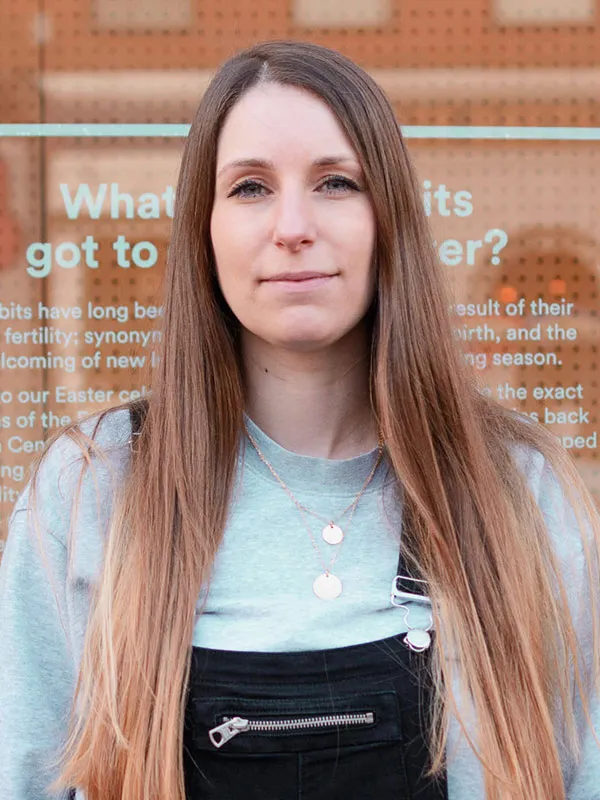
Carma Masson is an architect, educator and researcher with over a decade of experience across architectural practice, interior design and multidisciplinary design in London and Manchester. She is a Senior Lecturer in Architecture and Head of First Year at Leeds School of Architecture, where she leads curriculum development, teaching and admissions across the first-year programme. Her teaching and research interests centre on play, creativity and experiential approaches to architectural education and practice. Alongside teaching, Carma runs Playground Design Studio, exploring playful approaches to architecture and design. She is currently undertaking doctoral research at the University for the Creative Arts, focusing on playful architecture.
My PhD title:
Serious Play: Towards a Theory of Playful Architecture
My PhD summary:
Serious Play: Towards a Theory of Playful Architecture investigates play as a serious and valuable architectural condition, rather than as a superficial aesthetic, a form of enter-tainment, or an activity associated primarily with children and playgrounds. While theo-ries of play establish its significance as a fundamental mode of human engagement, playful architecture remains under-theorised within contemporary architectural dis-course. Existing approaches frequently position play within designated spaces, partici-patory activities or placemaking, rather than considering playful characteristics as an integral architectural and spatial strategy.
The research examines how playful architectural characteristics shape perception, movement, behaviour and emotional engagement with space. It explores what consti-tutes playful architecture, how its characteristics can be defined and categorised, and how research-through-design can generate knowledge about playful spatial experience. The research proposes that identifiable playful architectural characteristics can evoke playful behaviours and contribute to more engaging, emotionally connected and expe-rientially responsive environments.
The research adopts a practice-based approach, combining research-through-design and constructive design research with insights from design anthropology and participa-tory design. European case studies and practitioner interviews provide contextual and comparative insight, alongside iterative design experiments undertaken through archi-tectural studios, participatory workshops, public-facing installations and exhibitions. Observation, participant feedback and documentation of spatial interaction are used to investigate how playful environments are experienced by different users.
The research is developing a theoretical and methodological framework for playful ar-chitecture alongside an illustrated taxonomy of playful architectural characteristics. A design toolkit is also being developed to support students and practitioners in apply-ing playful characteristics within spatial design. The research contributes to architectur-al discourse by positioning play as a spatial and design methodology, demonstrating its potential to support richer forms of spatial engagement, participation and emotion-al connection.
Media enquiries
For media enquiries, please contact our Press Office Team: pressoffice@uca.ac.uk.